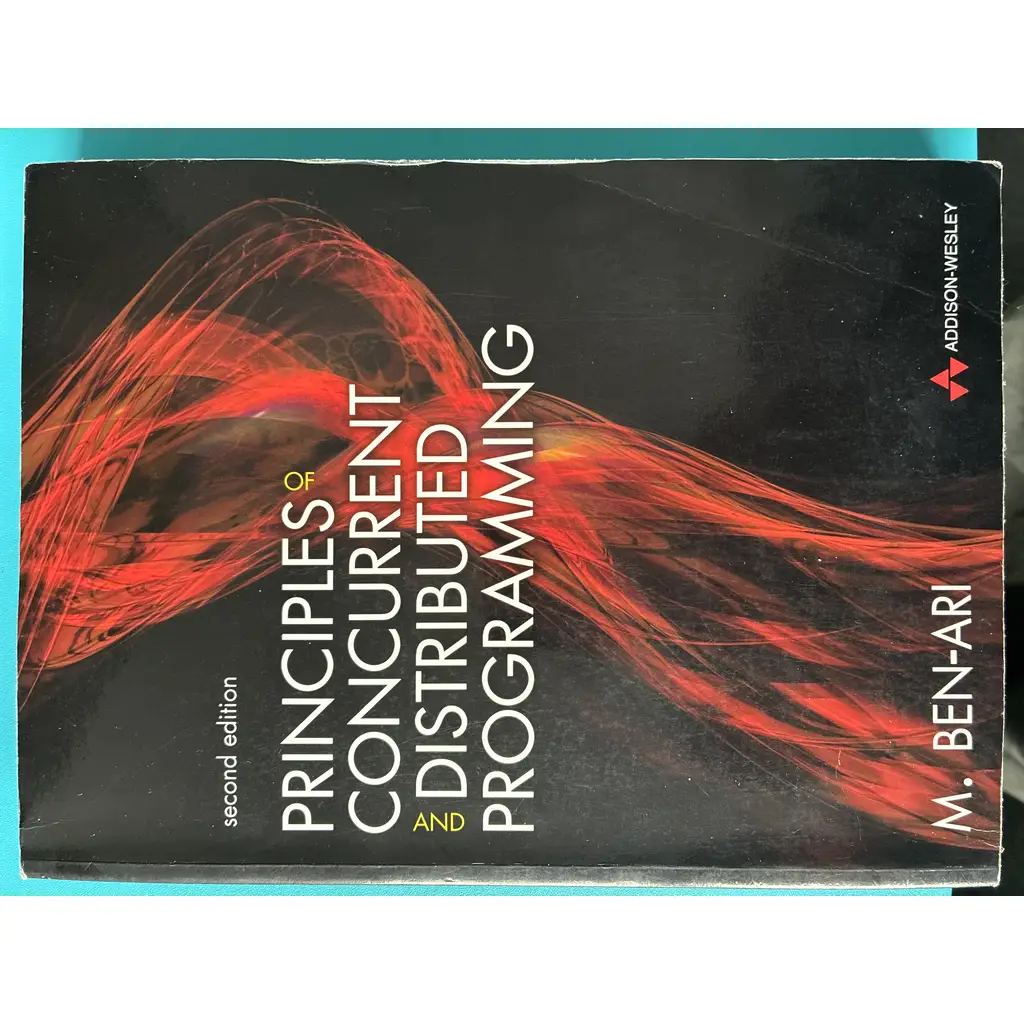

Principles of Concurrent and Distributed Programming
💲50.00
What the book is about (simple explanation)
At its core, the book teaches:
How do multiple processes or threads run at the same time
How they communicate and coordinate
How to ensure programs remain correct and safe despite parallel execution
It focuses on principles and theory, not just coding in a specific language.
1. Concurrency (Running things at the same time)
Programs don’t always run step-by-step sequentially
Tasks can overlap (e.g., downloading while computing)
The book models this as an interleaving of operations (like shuffling steps)
👉 Example:
Two threads updating the same variable can interfere with each other if not controlled.
2. Correctness problems
Concurrent systems can fail in subtle ways:
Race conditions – outcome depends on timing
Deadlocks – processes wait forever
Starvation – some processes never get resources
The book introduces formal ways to prove:
Safety (nothing bad happens)
Liveness (something good eventually happens)
3. Mutual Exclusion (critical section problem)
A fundamental problem:
How do you ensure only one process accesses shared data at a time?
The book explains:
Dekker’s algorithm
Hardware solutions
Locks and synchronization
4. Synchronization tools
Key mechanisms include:
Semaphores
Monitors
Message passing
Example:
Producer–Consumer problem (one produces data, another consumes)
5. Abstraction model
The book uses a mathematical abstraction:
Treat concurrent execution as interleaving atomic steps
Ignore hardware details to focus on correctness
This helps reason about complex systems clearly.
6. Distributed Systems
When processes run on different machines, new challenges appear:
Network delays
Failures
No global clock
Topics include:
Distributed algorithms
Communication protocols
Fault tolerance
7. Formal methods & verification
A big strength of this book:
Uses logic (like temporal logic)
Introduces model checking
Helps prove systems are correct before running them
This is more theoretical but very powerful in real systems.
🎯 What makes this book different
Focuses on “why things work”, not just “how to code”
Language-independent (uses pseudocode and concepts)
Strong emphasis on proofs and reasoning
Prepares you to analyze any concurrent system
👨🎓 Who should read it
Best suited for:
Computer science students (2nd year+)
Software engineers working with:
Multithreading
Distributed systems
Backend systems
⚠️ Not beginner-friendly if you’re new to programming—it assumes solid CS basics.
🧩 Real-world relevance
Even though it’s theoretical, the concepts apply directly to:
Operating systems
Databases
Cloud systems
Microservices
Multithreaded apps (like in .NET, Java, etc.)